
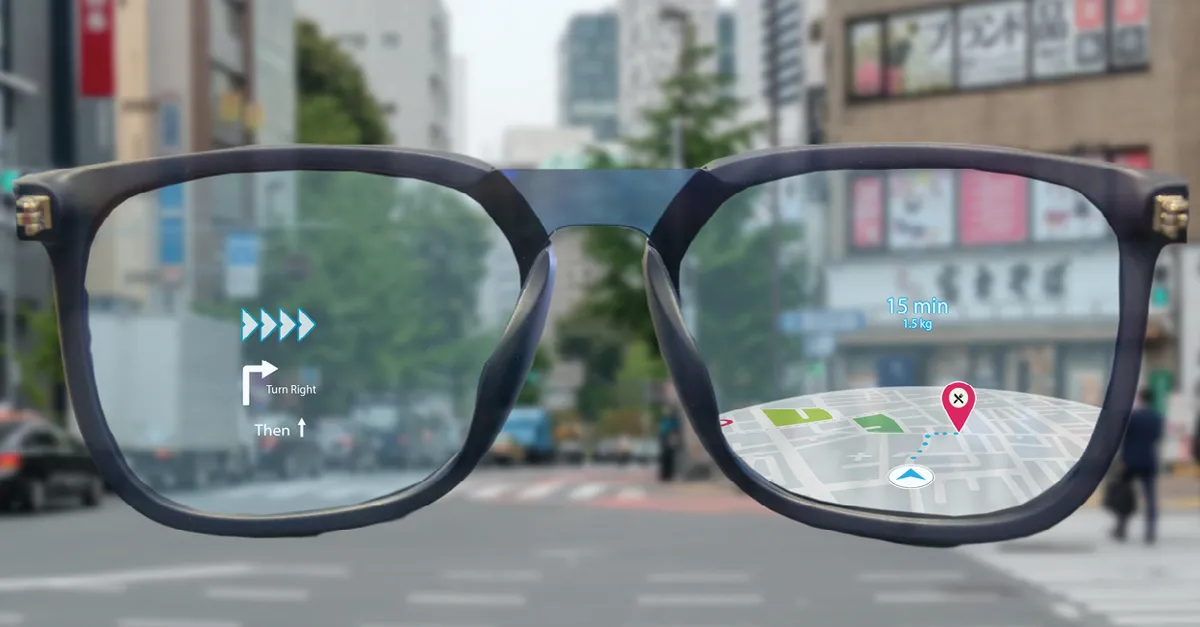
AR smart glasses are no longer just a futuristic idea from sci-fi movies—they are quickly becoming a real part of everyday life. Imagine walking down the street and seeing navigation directions floating in front of you, attending a meeting with real-time translations, or learning a new skill with interactive overlays guiding you step by step. This is the promise of augmented reality eyewear, and it is already reshaping how we interact with technology.
As digital experiences blend with the physical world, wearable AR technology stands at the center of the next major tech revolution. From consumers and professionals to industries like healthcare, manufacturing, and education, smart AR eyewear is opening doors to entirely new ways of seeing and understanding the world.
Table of Contents
ToggleWhat Are AR Smart Glasses and How Do They Work?
AR smart glasses are wearable devices that overlay digital content onto the real world through transparent displays. Unlike virtual reality headsets, which fully immerse users in a digital environment, AR glasses enhance the real world by adding interactive information on top of what you already see.
These devices typically use cameras, sensors, micro-displays, and processors to analyze the environment and project digital elements like text, images, 3D models, and notifications into your field of view. Some models also integrate voice control, gesture recognition, and AI-powered assistants to create a seamless hands-free experience.
Think of them as smartphones for your eyes—always accessible, always contextual, and always connected.
The Evolution of AR Smart Glasses: From Concept to Reality
The journey of AR smart glasses began decades ago in research labs and military projects. Early prototypes were bulky, expensive, and limited in functionality. However, rapid advances in optics, AI, and wearable computing have transformed them into sleek, consumer-friendly devices.
Companies like Google, Microsoft, Apple, Meta, and emerging startups have invested heavily in AR eyewear. Google Glass sparked mainstream interest, while enterprise-focused devices like Microsoft HoloLens demonstrated the practical value of AR in professional environments. Today, lightweight consumer models are entering the market, signaling a shift from niche technology to everyday wearable tech.
How AR Smart Glasses Are Transforming Daily Life
The real magic of AR smart glasses lies in their ability to seamlessly integrate digital information into daily activities. Imagine cooking while seeing recipe steps floating beside the ingredients, or walking through a foreign city with live translations appearing on street signs.
Students can visualize complex concepts in 3D, professionals can access real-time data while working hands-free, and consumers can shop with virtual try-ons that feel natural and immersive. These real-life applications are why AR eyewear is often described as the next smartphone revolution.
Key Features That Make AR Smart Glasses Powerful
Modern AR smart glasses are packed with cutting-edge features designed to enhance productivity and entertainment. High-resolution micro-displays provide crisp visuals, while spatial mapping technology ensures digital objects appear anchored to the real world.
Voice assistants allow users to control apps and search for information without touching a screen. Built-in cameras enable photo and video capture from a first-person perspective. Some models even include biometric sensors, enabling health monitoring and personalized experiences.
These features transform the glasses from simple accessories into intelligent companions that adapt to your lifestyle.
AR Smart Glasses in Healthcare and Medicine
One of the most impactful applications of AR smart glasses is in healthcare. Surgeons can view patient data and imaging scans directly in their field of vision during procedures, reducing the need to look away from the patient.
Medical students can learn anatomy through interactive 3D overlays, while remote consultations become more immersive with real-time guidance. AR eyewear also helps in rehabilitation therapy, where patients can follow guided exercises with visual feedback, improving outcomes and engagement.
AR Smart Glasses in Education and Learning
Education is undergoing a digital transformation, and AR smart glasses are accelerating this change. Imagine a classroom where students explore historical events through holographic reenactments or dissect virtual organisms without a physical lab.
Teachers can provide interactive lessons that adapt to each student’s learning style, while remote learners experience immersive virtual classrooms that feel more engaging than traditional video calls. This blend of physical and digital learning creates deeper understanding and better retention.
AR Smart Glasses for Business and Industry
In industrial settings, AR smart glasses are becoming essential tools. Technicians can receive step-by-step instructions while repairing machinery, reducing errors and training time. Warehouse workers can see picking routes and inventory details in real time, boosting efficiency.
In design and engineering, teams can visualize prototypes in 3D, collaborate remotely, and make real-time adjustments. These capabilities are redefining productivity and transforming how businesses operate.
Entertainment and Gaming with AR Smart Glasses
Entertainment is another area where AR smart glasses shine. Imagine playing a game where digital characters appear in your living room or watching a movie with interactive elements layered onto your environment.
AR eyewear brings immersive storytelling to life, blending the digital and physical worlds in ways traditional screens cannot. Social experiences also evolve, as users share AR-enhanced moments and interact with virtual content together in real time.
Privacy and Security Concerns Around AR Smart Glasses
While AR smart glasses offer incredible benefits, they also raise important privacy and security concerns. Built-in cameras and sensors can capture окружающая информация, which may lead to unauthorized recording or data misuse.
Developers and policymakers are working on privacy frameworks to ensure ethical use, including visible indicators when recording and strict data protection policies. As adoption grows, responsible design and user awareness will be critical to maintaining trust
Challenges Facing AR Smart Glasses Adoption
Despite their potential, AR smart glasses still face challenges. Battery life, device weight, and display quality remain areas for improvement. High costs also limit widespread consumer adoption, although prices are expected to decrease as technology matures.
Social acceptance is another factor. Wearing smart glasses in public can feel intrusive or awkward, but as designs become more stylish and mainstream, these concerns are likely to fade.
The Role of AI in AR Smart Glasses
Artificial intelligence plays a crucial role in enhancing AR smart glasses. AI algorithms analyze the environment, recognize objects, and deliver context-aware information in real time.
For example, AI-powered translation can display subtitles during conversations, while smart assistants anticipate user needs based on behavior and location. This combination of AR and AI creates a truly intelligent wearable experience that feels intuitive and personalized.
AR Smart Glasses vs Virtual Reality and Mixed Reality
Understanding the difference between AR, VR, and MR is important. AR smart glasses overlay digital content onto the real world, while VR immerses users in a fully virtual environment. Mixed reality combines both, allowing digital objects to interact with physical surroundings.
Each technology has unique use cases, but AR eyewear stands out for everyday applications because it enhances reality rather than replacing it. This makes it ideal for productivity, navigation, learning, and social interactions.
The Future of AR Smart Glasses in Consumer Tech
The future of AR smart glasses looks incredibly promising. As hardware becomes smaller and more powerful, these devices could replace smartphones as the primary computing platform. Imagine receiving calls, messages, and navigation directly in your field of view without ever pulling out a phone.
Major tech companies are racing to develop consumer-friendly AR glasses with sleek designs, long battery life, and affordable pricing. The next decade may see widespread adoption similar to the smartphone boom of the 2010s.
Real-Life Stories: How AR Smart Glasses Are Changing Lives
Consider a field engineer who uses AR smart glasses to receive real-time guidance from experts located thousands of miles away. Or a student who struggles with traditional textbooks but excels when learning through interactive AR visualizations.
These real-world examples highlight the transformative power of AR eyewear. By making information visible, interactive, and context-aware, AR technology empowers individuals and enhances human capabilities.
Ethical and Social Implications of AR Smart Glasses
As AR smart glasses become more integrated into daily life, ethical questions arise. How will constant digital overlays affect human attention and social interactions? Will people become overly dependent on augmented information?
Balancing innovation with ethical responsibility is essential. Developers must prioritize user well-being, digital wellness, and transparent data practices to ensure AR technology enhances human life rather than diminishing it.
Market Trends and Growth of AR Smart Glasses
The global market for AR smart glasses is growing rapidly. Industries such as healthcare, education, retail, and manufacturing are driving adoption, while consumer interest continues to rise.
Advancements in micro-displays, 5G connectivity, and AI are accelerating innovation. Analysts predict significant market expansion in the coming years, with AR eyewear becoming a key segment of the wearable technology industry.
How to Choose the Right AR Smart Glasses
Selecting the right AR smart glasses depends on your needs. Consumers may prioritize lightweight design, battery life, and entertainment features, while professionals may focus on enterprise software integration and rugged durability.
Understanding your use case—whether gaming, navigation, learning, or industrial work—will help you choose a device that delivers maximum value
The Impact of AR Smart Glasses on the Metaverse
The concept of the metaverse relies heavily on immersive technologies, and AR smart glasses play a central role. They provide a bridge between the physical world and digital spaces, enabling users to interact with virtual content in real environments.
As the metaverse evolves, AR eyewear could become the primary gateway to persistent digital layers that coexist with the physical world.
Future Innovations in AR Smart Glasses
Researchers are working on next-generation AR smart glasses with holographic displays, neural interfaces, and advanced spatial computing. Future models may offer contact-lens-like designs, ultra-long battery life, and seamless integration with brain-computer interfaces.
These innovations could redefine how humans interact with technology, making digital experiences more natural and intuitive.
AR smart glasses represent a powerful shift in how we experience reality. They blend digital intelligence with the physical world, unlocking new possibilities in communication, learning, work, and entertainment. As technology advances and adoption grows, AR eyewear is set to become an essential part of modern life, transforming the way we see, understand, and interact with the world around us.
xezic0.2a2.4
yezickuog5.4 model
how dk380c4.0-h8 model size
manoelaslva
is uchtinaypif chemical good

